UK VAT Invoice Template
United Kingdom sets its own rules for what an invoice must contain and how VAT appears on it — including where your vat registration number has to appear. This template handles both: pick your rate and the lines, the wording and the arithmetic follow.
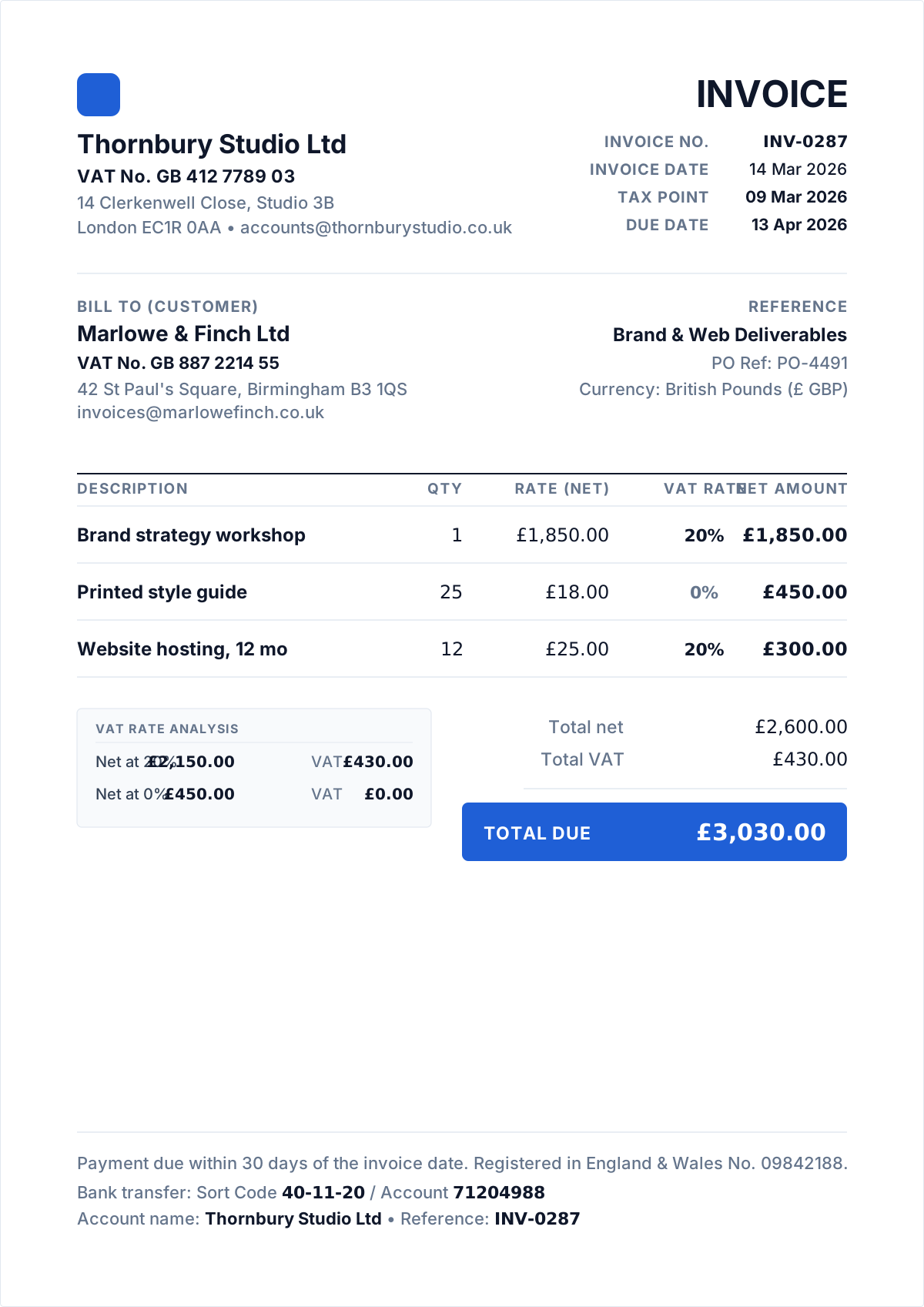
What GOV.UK requires on the document
10 things have to appear before this counts as a valid invoice in United Kingdom. The one people miss most often is the vat registration number, which belongs near your business details where an accounts team looks for it.
- A unique, sequential invoice number
- Your business name and address
- Your VAT registration number
- The invoice date
- The time of supply (the tax point) if different from the invoice date
- The customer's name and address
- A description of the goods or services supplied
- The VAT rate applied to each item, and the amount excluding VAT
- The total amount excluding VAT
- The total VAT charged, in sterling
Verified against GOV.UK on 2026-09-11.
The tax point, and why it is not the invoice date
UK VAT has a concept most invoicing tools ignore entirely: the time of supply, or tax point. It decides which VAT period the sale falls into, and it is not automatically the date you typed at the top of the invoice.
- The basic tax point is the date the goods were delivered or the service completed — not the date you got round to invoicing.
- If you issue the invoice within 14 days of that, the invoice date becomes the tax point instead. Invoice later and the earlier date stands.
- Take payment first, and the tax point is the date you received the money, for that amount.
- Where the two differ, HMRC expects both dates on the document.
This matters at quarter ends. An invoice raised on 3 April for work finished on 28 March belongs in the earlier VAT period, and filing it in the later one understates that return.
Simplified invoices, and when £250 changes things
Retail supplies up to £250 including VAT can use a simplified invoice, which is a genuinely shorter document rather than a relaxed version of the same one.
- It may omit the customer's name and address entirely.
- It shows the gross amount per VAT rate rather than net plus VAT.
- It still needs your name, address, VAT number, the date, a description, and the rate applied.
- Above £250, or for any business customer who will reclaim the VAT, issue a full VAT invoice.
A business client cannot reclaim input VAT from a document that fails the full requirements, so a simplified invoice sent to a company is likely to come straight back.
VAT registration and the value thresholds
The rules below only bite past a certain amount, which is what makes them easy to miss — an invoice that was fine last month becomes non-compliant the first time it crosses the line.
- A simplified VAT invoice is allowed for retail supplies up to £250 including VAT — it can omit the customer's details and show the gross amount per rate.
- VAT registration is compulsory once taxable turnover passes £90,000 in any rolling 12 months.
- If you are not VAT registered, do not show a VAT line or a VAT number. Charging VAT without registration is an offence.
VAT rates
Pick the rate matching what you supply. The generator applies it as a named line, which is how a client's accounts team expects to see it.
| Applies to | VAT | Combined | Notes |
|---|---|---|---|
| Standard rate | VAT 20% | 20% | |
| Reduced rate | VAT 5% | 5% | Domestic fuel and power, children's car seats, some energy-saving materials. |
| Zero-rated | VAT 0% | 0% | Most food, books, children's clothing. Zero-rated is not the same as exempt — zero-rated sales still count towards your turnover and let you reclaim input VAT. |
| Exempt or unregistered | No tax line | — | Below the registration threshold, or supplying exempt goods and services. Do not show a VAT line at all. |
Note: Rates shown for United Kingdom, checked against GOV.UK on . Tax rates change by legislation, not on a schedule — confirm yours before sending an invoice.
Sources
The requirements on this page come from the authorities that set them. Rules change — check the source before relying on it.
- VAT invoices — what they must show — GOV.UK
- VAT rates on different goods and services — HM Revenue & Customs
- VAT registration thresholds — GOV.UK
Frequently asked questions
What VAT rate should I charge in United Kingdom?
VAT 20% — standard rate; VAT 5% — reduced rate; VAT 0% — zero-rated. Choose the one matching what you supply; the generator adds the line and does the arithmetic.
Do I need a vat registration number to invoice?
You can invoice without one, but you cannot charge VAT without being registered. VAT registration is compulsory once taxable turnover passes £90,000 in any rolling 12 months.
Is a PDF invoice valid in United Kingdom?
Yes for business-to-consumer and for B2B today. From April 2029 the UK moves to Peppol-based e-invoicing for B2B, and HMRC has said explicitly that PDFs and Word documents will not qualify for it. Nothing changes for B2C or for sole traders below that scope.
Can I use this template if I am not registered for tax?
Yes, and you should not show a tax line at all. Charging VAT while unregistered is an offence in most jurisdictions. Pick the "no tax" option and the line is omitted rather than shown as zero, which is a different statement.
Does the invoice have to be in a specific currency?
The generator defaults to GBP for United Kingdom, which is what a domestic client expects. You can invoice in another currency for an overseas client — though the total VAT must still be shown in sterling.
Ready to invoice?
Fill in the generator, download the PDF, and send it. No signup, no watermark, and your details stay in your browser.
Create your free invoice